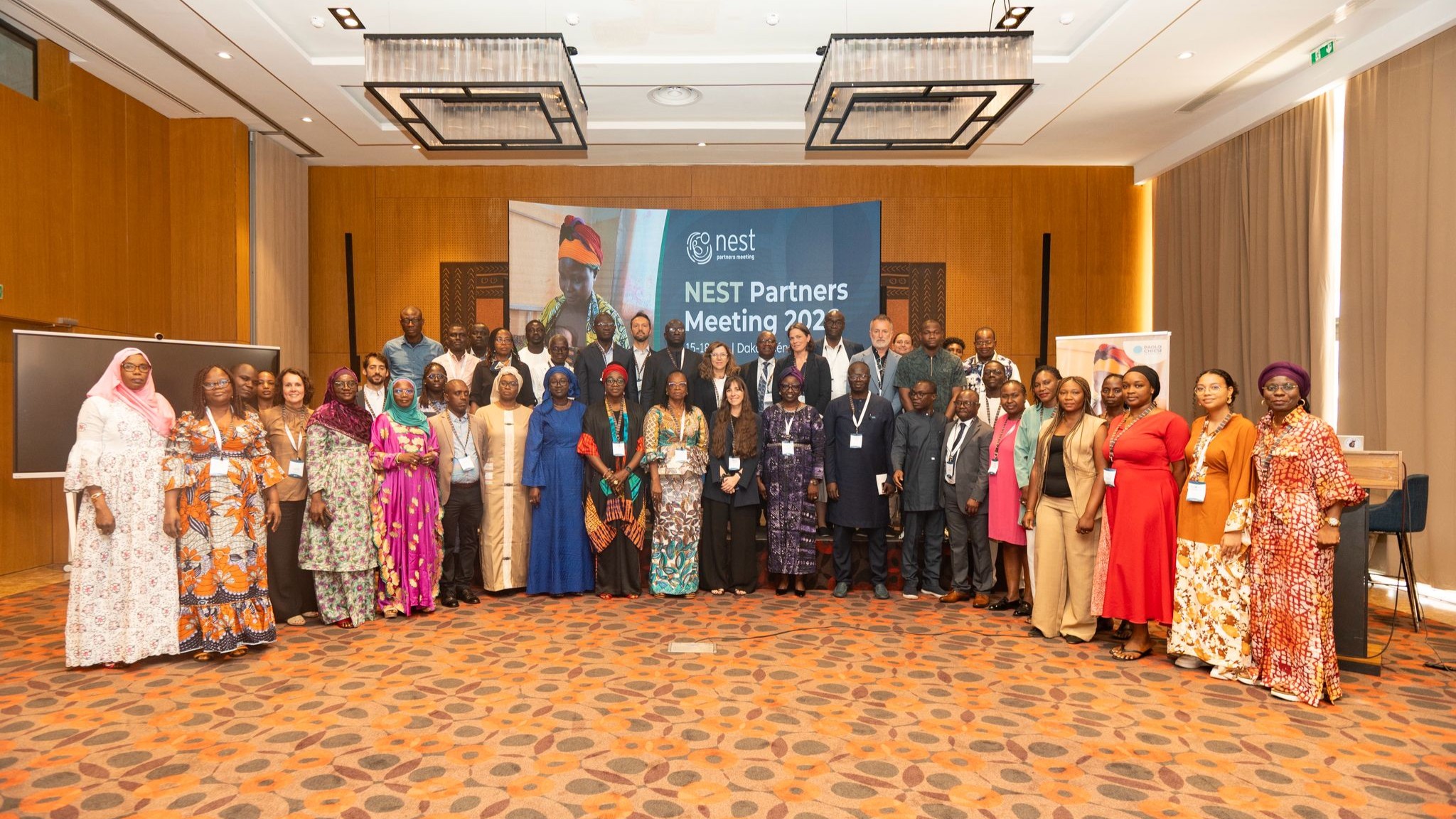
Improving the quality of care for every newborn and reducing preventable deaths: this shared challenge shaped the NEST Partners Meeting 2026, held in Dakar from 15 to 18 June, which brought together partners, healthcare professionals and global health stakeholders committed to improving neonatal care in low-resource settings.
For four days, partner hospitals, healthcare professionals, international organizations and institutional representatives exchanged views on what is happening across the different contexts where the NEST Model is being implemented, with a concrete objective: to turn experience and knowledge into coordinated and sustainable action.
The 2026 edition involved partners from several countries in sub-Saharan Africa, including CHU-MEL Hospital in Cotonou and Saint Jean de Dieu Hospital in Tanguiéta (both in Benin), Saint Camille Hospital in Ouagadougou (Burkina Faso), Ngozi Regional Hospital (Burundi), Treichville Hospital in Abidjan (Côte d’Ivoire) and Yendube Pediatric Hospital in Dapaong (Togo), together with the Foundation team, representatives from the Central African Republic, the Italian Society of Neonatology, the Centre Hospitalier National d’Enfants Albert Royer and several international stakeholders, creating a working space that connected experiences, expertise and complementary perspectives.
A space for exchange on neonatal health
The NEST Partners Meeting is a working environment built around direct exchange among partners operating in similar settings. Field experience is not only shared, but used to identify solutions and consolidate approaches that are already producing results.
This perspective guided the entire meeting, alternating moments of strategic alignment with operational sessions. From the first day, it became clear that improving neonatal outcomes does not depend solely on clinical interventions, but on the ability to strengthen care systems as a whole.
Within this framework, family-centered care plays an essential role in neonatal care. The active involvement of families helps improve newborn outcomes, reduces parental stress and makes the work of healthcare teams more effective.
The discussions also highlighted the importance of collaboration at multiple levels: within hospitals, across different facilities, and in dialogue with institutions and technical and financial partners. Strengthening these connections is necessary to overcome challenges and ensure the continuity of quality care.
Clinical and practical training: resuscitation and respiratory distress
Clinical training was one of the pillars of the NEST Partners Meeting 2026, offering participants the opportunity to explore two fundamental areas for newborn survival: the management of respiratory distress and neonatal resuscitation.
The first day was dedicated to neonatal respiratory distress. After a theoretical session led by Prof. Ndiaye and Prof. Tchagbele, participants reviewed the results of an assessment conducted by the African Neonatal Association (ANA) on the use of Continuous Positive Airway Pressure (CPAP) in the countries of the NEST network. The analysis made it possible to compare practices, challenges and opportunities for improvement across different contexts. Partner hospitals then shared their own experiences in implementing CPAP, presenting clinical protocols and organizational approaches adopted locally. The exchange among professionals from different countries encouraged the sharing of practical solutions and practices that can be applied in other settings within the network.
The second day focused on neonatal resuscitation. After a theoretical introduction to the main recommendations and procedures by Prof. Solange Ouedraogo, participants took part in practical sessions at the Centre National Hospitalier d’Enfants Albert Royer in Dakar. Through clinical simulations based on realistic scenarios, they were able to practice essential skills for managing the first minutes of a newborn’s life. The exercises included the use of the AIR Device, a technology that provides real-time feedback on the quality of ventilation and supports skills development through practice.
The day ended with a visit to the neonatal ward, offering direct insight into how the practices discussed are integrated into daily care routines. Taken together, these sessions confirmed a central element of the NEST approach: starting from concrete problems to develop shared, applicable and replicable solutions.
Dialogue with international stakeholders and institutions
The day dedicated to dialogue with the global health system marked a key moment of the meeting. After the introductory remarks by Maria Paola Chiesi and Massimo Salvadori, respectively President and Managing Director of the Foundation, the discussion focused on what it means to translate commitment into concrete impact within health systems.
Federica Cassera presented the NEST Model as a high-impact and replicable approach to strengthening the quality of neonatal care through training, data use and the enhancement of local expertise. Prof. Ousman Ndiaye then provided an overview of neonatal mortality in sub-Saharan Africa, highlighting the need to expand access to effective, high-quality interventions.
The discussion involved a broad group of international stakeholders — including the Directorate of Maternal and Child Health of the Ministry of Health and Public Hygiene of the Republic of Senegal, UNICEF, World Health Organzation, Global Financing Facility, Gates Foundation, Laerdal Global Health, and African Neonatal Association — contributing to a rich discussion shaped by complementary perspectives from institutions, research, international cooperation and clinical practice.
The different contributions fed into a final roundtable focused on identifying the most effective and immediately applicable interventions to reduce neonatal mortality, as well as the conditions needed to support their adoption at scale. Although starting from different experiences and roles, stakeholders highlighted several common elements: the need to invest in strengthening the skills of healthcare workers, promote the use of data to guide decisions, support validated high-impact interventions and reinforce coordination across the different levels of the health system. The discussion also emphasized the value of partnerships in turning knowledge and evidence into concrete and sustainable improvements for newborns and their families.
Results and perspectives of the NEST Model
A significant part of the programme was dedicated to Family-Centered Care (FCC), understood as a fundamental element of quality neonatal care and of the active involvement of families in care pathways. The session opened with an introduction by Federico Bianco, Technical Advisor of the Foundation, who presented the principles of FCC and its role in improving clinical outcomes and the care experience, particularly in highly vulnerable settings.
The focus then moved to Kangaroo Care (KC), as a concrete example of FCC implementation in neonatal services. In this framework, Dr. Ousman Mouhamadou presented the “Satisfaction Soins Mère Kangourou” project, which involved partners in a structured process of collecting and analysing data on the satisfaction of mothers and families admitted to the KC units of partner hospitals.
In the months leading up to the NEST Partners Meeting, hospitals in the network collaborated on the definition of a questionnaire, data collection in their own settings and the analysis of results, which were presented during the meeting through a dedicated poster session. This activity represented not only a moment of scientific exchange, but also an important opportunity to strengthen partners’ skills in operational research and data analysis.
The day concluded with the presentation of the experience of Saint Jean de Dieu Hospital in Tanguiéta, which illustrated the impact of the NEST Model in its own context. The case offered a concrete example of how the integration of FCC, KC and the strengthening of clinical practices can translate into real and measurable improvements in the quality of neonatal care.
A network strengthened through exchange
The meeting confirmed the value of a space where those working every day in the field can compare experiences, share solutions and consolidate effective approaches. It is through this exchange that a network becomes stronger and able to turn dialogue into concrete and sustainable action.
Beyond Dakar: from exchange to action
The NEST Partners Meeting 2026 closed with a clear message: improving neonatal health requires shared, continuous work rooted in local contexts.
The work does not end with the meeting: it continues in wards, healthcare teams and care systems where the NEST Model is applied every day. This is where exchange becomes practice and where interventions generate measurable results for newborns and their families.
For the Paolo Chiesi Foundation, Dakar represents a significant step in a broader path aimed at integrating and supporting effective care models within health systems, contributing over time to concrete and lasting improvements in neonatal health.