In Burundi, the neonatal mortality rate still reaches 25 deaths per 1,000 live births. A number that weighs like a destiny—but one that must not be accepted as such.
For twenty years, the Paolo Chiesi Foundation has been committed to improving access to quality neonatal care in low‑resource countries. This year, the Foundation has chosen to allocate the funds that will be received through the 5×1000 tax designation to a project capable of changing the future of thousands of children: the implementation of Kangaroo Mother Care (KMC) in the Health Centers of the Bunyerera health province, in the northern part of the country.
Why Burundi? Why now?
Burundi is a country where childbirth often occurs in challenging conditions: limited health infrastructure, lack of trained personnel, and scarce essential equipment. Health Centers are the primary point of access to care for most mothers and newborns, yet they still lack the skills and tools needed to assist them at birth and during the first months of life, when continuous support is essential, including medical follow‑ups and vaccinations.
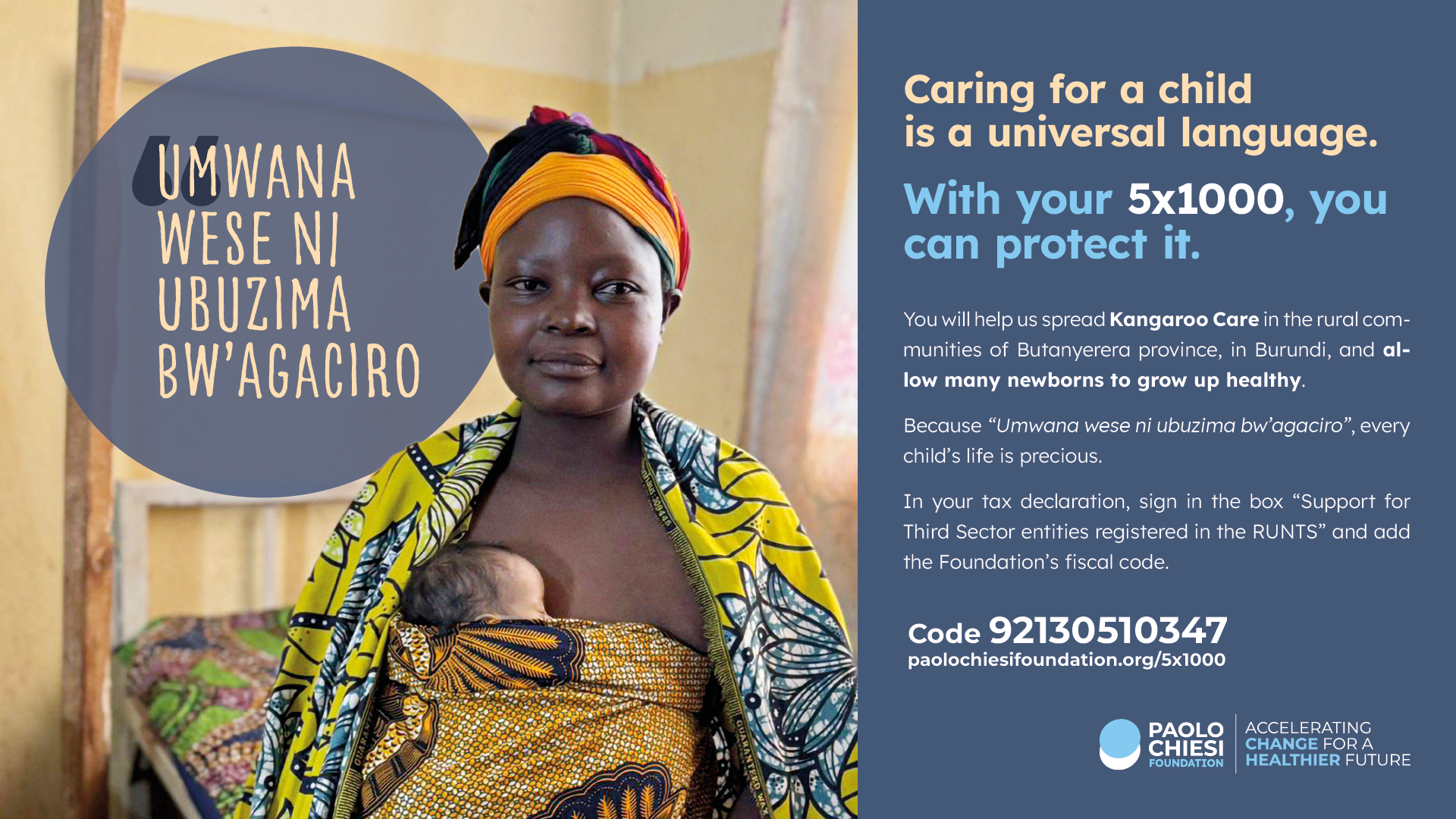
The project—named “Umwana wese ni ubuzima bw’agaciro: kuvuka mu rukundo no mu mutekano”, meaning “Every child is a precious life: born in love and safety”—is the natural continuation of phases 1 and 2, implemented by the NGO Amahoro pro Africa with the Foundation’s support. After establishing the KMC Training Center at the Regional Hospital of Ngozi, the time has come for the decisive step: strengthening the continuity of care between the hospital, the Health Centers, and the community, so that every mother‑newborn pair receives essential, appropriate, and timely care from birth, and every premature newborn discharged from the hospital can be adequately followed close to their home.
The Value of Kangaroo Mother Care
Kangaroo Mother Care is one of the most effective and accessible strategies to improve survival rates of premature and low‑birth‑weight babies. Originally developed as a simple, sustainable response to the limitations of health facilities in low‑resource settings, it combines clinical rigor with human connection, becoming a true philosophy of care.
KMC is based on three inseparable elements: prolonged skin‑to‑skin contact, exclusive breastfeeding, and continuous clinical monitoring. Together, these help prevent hypothermia and infections, reduce complications linked to prematurity, and foster a strong emotional bond between parents and babies. For many families—especially in fragile contexts like Burundi—KMC is a lifesaving solution that can be applied even where resources are extremely limited.
A decisive intervention in fragile contexts
In many low-income countries, equipment such as incubators or technological devices is scarce, access to electricity is not guaranteed, and healthcare staff are often insufficient. In circumstances like these, KMC proves to be a practical and replicable solution, capable of providing effective care not only in hospitals but also in the most remote communities. Indeed, neonatal survival depends as much on hospitals as on the quality of essential care at birth and on follow-up carried out in peripheral facilities. For this reason, it is crucial to strengthen simple yet high-impact practices in Health Centers, such as immediate skin-to-skin contact between mother and newborn, the promotion of breastfeeding, prevention of hypothermia, early identification of danger signs, and correct referral to the hospital when necessary.
A family‑centered model of care
Emotional and physical closeness becomes a therapeutic resource: it helps the newborn recover more quickly, reduces maternal stress, and strengthens parental skills, which are essential to ensure continuity of care after discharge. By selecting and involving 12 Health Centers, the project aims to build a bridge between the hospital and the home, creating a network that includes partners, healthcare workers, and the wider community, which is transformed into a place of support rather than of stigma. On the one hand, we will ensure that every baby born at the Health Centers receives essential, quality care and skin-to-skin contact at birth; on the other, we will guarantee that former premature infants, after being discharged from the hospital, are adequately followed up through a structured system of counter-referral, growth monitoring, breastfeeding support, and regular check-ups.
This model strengthens the social fabric, overcomes cultural barriers, and restores dignity and autonomy to mothers, making every family an active protagonist in their child’s well-being.
A project that starts with the community and returns to the community
The project—implemented by WeWorld, with the support of the Paolo Chiesi Foundation and in coordination with the Programme National de Santé Réproductive (PNSR) of the Burundian Ministry of Health—will involve 12 Health Centers and the Community Health Agents from their respective villages, through the implementation of the following activities:
- adaptation of the National KMC Manual under the guidance of the PNSR
- targeted training for 153 staff members (healthcare workers, health promoters, and community workers)
- involvement of 6 national trainers to ensure continuity and widespread dissemination
- development of bilingual educational materials (Kirundi–French)
- structured clinical supervision and monitoring
- community awareness-raising to overcome cultural barriers and improve acceptance of prematurity
Who are the beneficiaries?
- Direct: 153 health professionals and hundreds of at-risk newborns
- Indirect: thousands of families, expectant mothers, and the entire local community
All of this makes a concrete contribution towards the achievement of Sustainable Development Goal (SDG) 3.2 of the United Nations 2030 Agenda, which aims to end preventable neonatal deaths by 2030.
Why should you allocate your 5×1000 to this project?
Choosing to allocate your 5×1000 to the Paolo Chiesi Foundation means:
- transforming a simple signature into tangible care, supporting a high-impact, sustainable project rooted in the community
- contributing to the spread of advanced neonatal skills in settings where every intervention can make a real difference
- supporting the Foundation’s commitment to promoting equitable access to care
How does the 5×1000 work?
Allocating your 5×1000 is a simple, free gesture within everyone’s reach. It is a practical way to support projects that improve people’s lives, without any additional cost to the taxpayer.
Who can donate it?
All individuals who file a tax return in Italy can choose to allocate their 5×1000 to their preferred beneficiary:
- those who complete the Modello Redditi (formerly Unico)
- those who use the Modello 730
- even those exempt from filing a tax return can still submit the relevant form at a CAF (tax assistance center), to an accountant, or at a post office.
How much does it cost?
Absolutely nothing. The 5×1000 is not an additional tax: it is a portion of the income tax (IRPEF) that you already pay to the State. If you do not choose a beneficiary, that portion remains with the State. With a simple signature, however, you can decide to turn it into real support.
How to allocate it to the Paolo Chiesi Foundation
In the section “Allocation choice—5×1000 of your personal income”, simply:
- sign in the box dedicated to the “Support for Third Sector entities registered in the RUNTS”
- enter the Foundation’s tax code: 92130510347
Do you need to know the amount?
No. The Tax Authority (Agenzia delle Entrate) will automatically calculate the share based on your IRPEF tax.
Can you donate the 5×1000 to the Foundation and the 8×1000 or 2×1000 to other organizations?
Yes. The choices are not mutually exclusive: you can select all the options at the same time.
How will 5×1000 be used?
The Paolo Chiesi Foundation publishes its projects, results, and financial reports every year on its official website and within the Social Report, ensuring transparency and accountability in the use of the funds invested.
A story we can change together
Every child has the right to be born safely, surrounded by love and proper care. Every mother has the right to a protected, respectful, and peaceful birth. Every community deserves the tools and knowledge to secure a better future for its children.
The project “Every Child is a Precious Life” embodies this commitment. With your 5×1000, you can be part of it.